
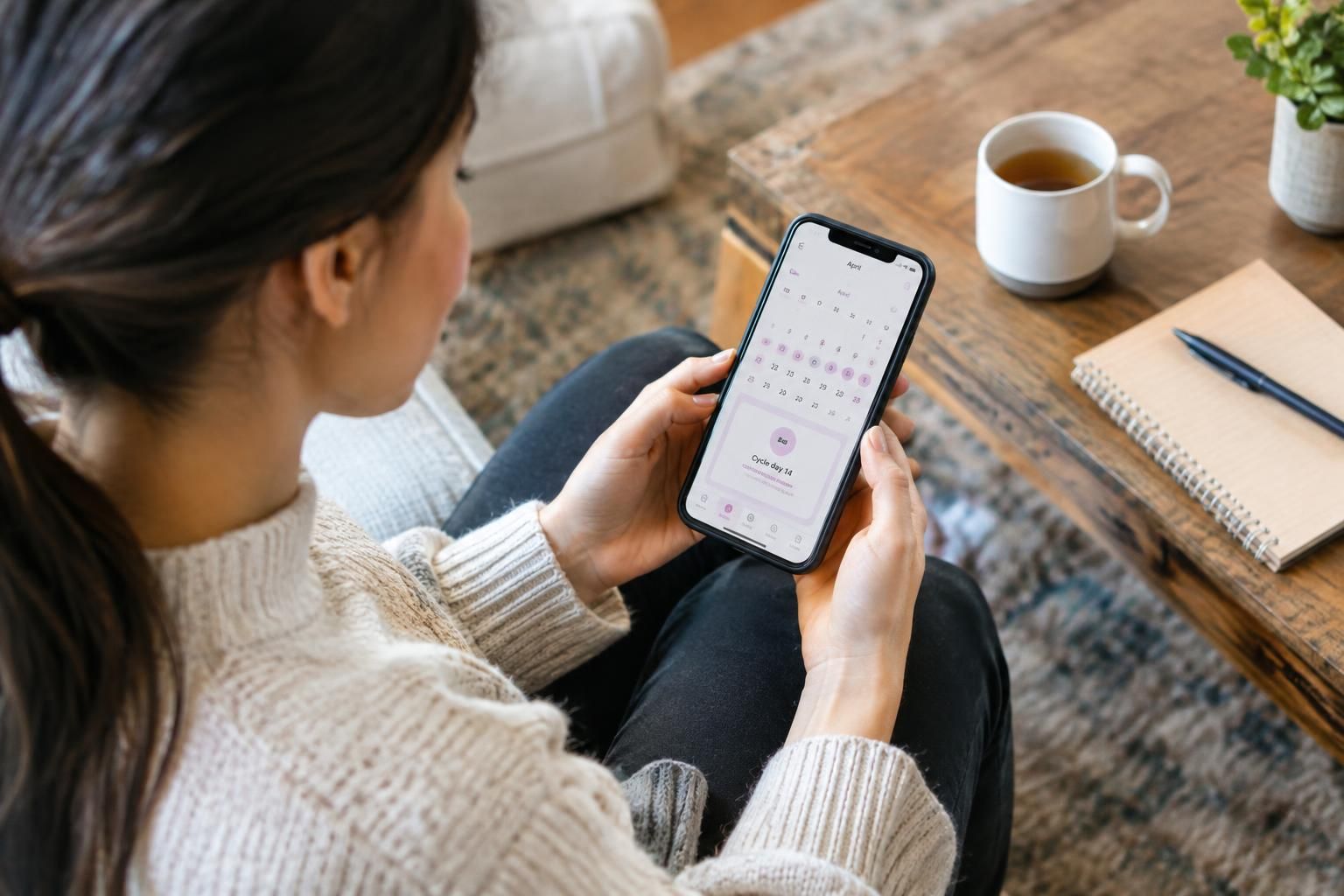
Your app predicts “high energy” on Tuesday. Tuesday arrives with a bad night of sleep, a surprise deadline, and no desire to do the workout you planned. This is where cycle tracking becomes either useful information or one more system telling you that your body is behaving incorrectly.
Cycle tracking and energy can help you notice personal patterns, but the pattern should come from your observations—not from a viral chart that assigns a personality and workout style to every phase. Sleep, stress, illness, food, medication, workload, and individual biology all affect how you feel. The calendar is context, not a command.
The calendar prediction that did not match Tuesday
Imagine that an app predicts a wonderful high-energy day. Tuesday arrives with a demanding presentation, short sleep, and a headache. You open the app and wonder why your body did not follow the chart. This is an easy trap: a tool that was meant to create awareness becomes another set of expectations. Individual experiences vary, and a calendar cannot fully account for stress, illness, sleep, and the unpredictable demands of real life.
A better approach is to record what happened without judging it. Notes about symptoms, bleeding, sleep, and energy can help you notice patterns across several cycles. They are not instructions to feel cheerful on a particular day or to avoid a workout because someone online declared a phase “bad for training.” Give lived experience more authority than a colorful dashboard.
Start with observations, not a viral cycle chart
Online cycle-syncing advice can sound remarkably specific: train hard on these days, eat this food on those days, and expect a certain level of motivation. Individual experiences vary too much for a single chart to guide everyone accurately.
Instead, notice the basics for a few cycles: when bleeding starts, whether cramps or headaches interfere with activities, roughly how you slept, and whether a symptom feels unusual. Keep the notes short enough that you will actually use them.

Separate symptoms from assumptions
A low-energy day does not automatically mean your hormones are the cause. You may have slept poorly, skipped lunch, worked long hours, or been fighting an infection. Looking at context can prevent a tracking app from turning into an overly confident explanation.
Our article about bedtime procrastination describes one way late nights develop even when people intend to rest. Keeping sleep and work demands in the picture makes your observations more useful.
Let exercise respond to how you feel
Some women enjoy training throughout the month with few adjustments. Others modify activity when cramps or fatigue feel limiting. There is no universal schedule that requires certain exercises on particular cycle days.
Choose the movement that fits your symptoms and goals. A walk, a strength session, or a rest day can all be reasonable. If you are building an exercise routine, our beginner hybrid-training article offers a flexible framework without pretending that your body follows a calendar perfectly.
Make food and rest the boring foundation
Regular meals and enough rest are more useful starting points than buying a collection of hormone-balancing supplements based on social media claims. If your appetite changes across the month, notice what helps you eat comfortably and consistently.
If you have severe fatigue, unusually heavy bleeding, or symptoms that interfere with normal life, it is worth seeking medical advice. No general wellness article can diagnose anemia, thyroid problems, or menstrual conditions from an energy diary.
Use tracking tools with privacy in mind
Apps can be convenient, but they collect personal health information. Before entering sensitive details, look at privacy settings, data-sharing policies, and whether you actually need the extra features. A private paper calendar may work just as well.
Keep your entries focused on questions you want to answer. You might care about headaches and sleep more than fertility predictions. Tracking is optional, and it is not proof that you are taking better care of yourself than someone who does not track.
Recognize that midlife patterns are different
Young-adult cycles and the changes that can happen during perimenopause are not the same topic. For context on a later life stage, our article about cravings in perimenopause explains why appetite and routines may feel different for some women in midlife.
That does not mean a twenty-year-old should interpret every symptom through a midlife framework. If a period is absent, unusually painful, very heavy, or otherwise concerning, seek individualized clinical guidance rather than guessing from an online chart.
Avoid giving every mood a hormonal label
It can feel reassuring to assign a difficult afternoon to a particular cycle phase. Sometimes the timing is useful to notice; other times the explanation may be sleep deprivation, a deadline, or simply a rough day. Keep several possibilities open rather than treating a tracking app as a diagnostic tool.
If your mood changes feel severe, persistent, or disruptive to relationships and functioning, a clinician can help assess them. The purpose of tracking is to provide better context for your decisions and conversations, not to make you responsible for solving every symptom on your own.
Share information thoughtfully with a clinician
If you decide to seek care, a short record of dates, symptom severity, and how they affect daily activities may help you describe what has been happening. You do not need a complicated spreadsheet; a few consistent observations are often more useful than years of incomplete data.
Keep room for uncertainty. Many conditions share symptoms, and menstrual-cycle tracking cannot identify their cause by itself. Bring questions, not a self-diagnosis, to the appointment. That approach respects both your observations and the need for professional assessment.
Questions that make tracking more useful
Ask whether a symptom is new, whether it repeats, and whether it changes your daily activities. A single difficult workout tells you little. A recurring pattern of severe pain that keeps you home from school or work may be important information to share with a clinician. Distinguishing the two helps the diary serve a practical purpose.
Avoid collecting more information than you need. If every small fluctuation sends you searching for an explanation online, consider simplifying the log or taking a break from tracking. You deserve care that supports your life, not an endless stream of notifications about how your body might feel next Thursday.
Track fewer things, but make them things you can use
Choose three or four observations that matter to you: bleeding, sleep quality, energy, pain, mood, or training difficulty. A quick 1–5 rating plus a short note is often more useful than a dashboard with twenty categories you stop completing after a week.
Privacy matters too. Before using an app, look at what data it collects, how it is stored, and what controls you have. A paper calendar or encrypted note may be perfectly adequate if you mainly want to spot patterns for yourself or bring clearer information to a healthcare visit.
Plan the workout, then give yourself three versions
Instead of assigning a hard workout to a phase, create three versions of the same session: full, shorter, and very easy. On a day you feel strong, do the full plan. On a lower-energy day, reduce volume. If symptoms or fatigue are significant, choose rest or gentle movement.
This approach respects the useful part of tracking—paying attention—without forcing the data to predict you. It also makes the plan more resilient to normal life, which rarely aligns perfectly with a cycle app.
The conversation you may want to have with a clinician
It can be difficult to remember details in an appointment, especially if the symptoms were worse three weeks ago. A brief note that says “missed two classes because of pain” is more actionable than “my cycle feels strange.” Describe the change, how long it has been happening, and what it prevents you from doing. Bring questions about contraception, medication, or other health factors if relevant.
A cycle log cannot diagnose a condition, but it can help make a conversation specific. You do not need to prove that every fluctuation has a hormonal cause to deserve support. Sometimes the most valuable outcome of tracking is recognizing that a symptom needs attention rather than another attempt at self-optimization.
Ask one question before you look at the prediction
Before you open the app, ask: “How do I actually feel today?” Then compare that answer with the prediction. Over time, the difference between the two can teach you more than simply following the app. If symptoms are new, severe, or disruptive, bring the pattern to a clinician rather than trying to optimize around it.
For readers in midlife, cycle changes can look different again. Our guide to brain fog after 40 and our perimenopause articles explore that stage separately.
What a useful pattern actually looks like after three months
A pattern is not “I felt tired on day 22 once.” It is something that repeats often enough to be worth discussing or planning around. You might notice that cramps reliably change what exercise feels comfortable, that sleep is worse before bleeding begins, or that energy has no obvious relationship to cycle phase at all.
All three outcomes are useful. Tracking is successful when it gives you better questions, not when it confirms a social-media chart. If periods are very heavy, very painful, absent unexpectedly, or accompanied by symptoms that concern you, the log can help a clinician see timing and severity more clearly.
Try one low-pressure cycle log
>
- Track only the observations you genuinely care about.
- Record how you feel before checking an app prediction.
- Create full, shorter, and easy versions of your planned workouts.
- Review app privacy settings and decide whether the platform is worth the data you share.
- After one or two cycles, look for repeated patterns rather than trying to explain every individual day.
Frequently asked questions
Can a cycle app predict my daily energy exactly?
No. Apps may estimate dates, but they cannot account for all the factors that affect an individual’s energy, sleep, and health.
Should I change workouts every week of my cycle?
Not necessarily. Adjusting for symptoms can be useful, but there is no single cycle-based training plan everyone must follow.
When should period symptoms be checked?
Severe pain, unusually heavy bleeding, fainting, unexplained fatigue, or major changes to your usual pattern deserve medical attention.
Cycle tracking and energy notes work best as a conversation with yourself, not a command from a chart. Keep observations simple, look for patterns over time, and leave room for the many ordinary reasons one day can feel different from the next.